
Most traders spend more time arguing about entries than asking a simpler question: who exactly is on the other side of my order flow. The “type of broker” you use defines how your orders are routed, who holds your money, which fees you pay, and even how likely you are to get filled in fast markets.
A broker, in simple terms, sits between you and a market or product you cannot access directly. That could be the equity market through an exchange, the interbank forex market, the futures market through a clearing house, or even crypto liquidity pools. Different brokers connect you to different things, with different incentives.
For someone with basic trading knowledge, the labels can look messy. You will see full-service, discount, ECN, STP, market maker, DMA, FCM, prime, introducing broker, crypto exchange and more, often mixed in the same marketing page. The labels are not just branding. They describe business models, and those models shape your trading experience.
This article walks through the main broker categories you will meet as a retail or semi-professional trader, explains how they actually work, and gives you a mental model to choose what fits your capital size, products and style.
The focus is practical. No hype, just how the plumbing works and what that means for your account. If you cam here looking to find a broker to trade with then I recommend that you visit Broker Listings. Brokerlisting.com is a website that makes it very easy to find and compare brokers.
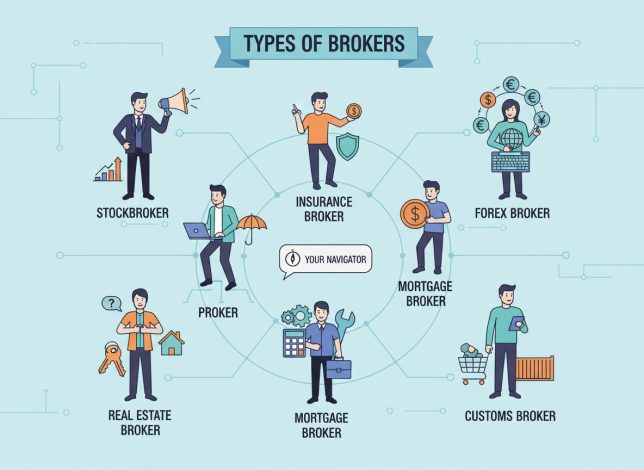
Retail stock brokers: full-service, discount and “zero-commission”
Most people meet their first broker through equity trading. Here, three broad models show up: full-service, traditional discount, and the newer “zero-commission” online style.
Full-service brokers are the old-school option. They offer human advisers, phone dealing desks, in-person meetings, and a bundle of research, portfolio suggestions and planning. Fees are usually higher. You may pay per trade, a percentage of assets under management, or both. In this model you are paying not only for access to the market but for advice, reports and handholding. For an active trader who already knows what they want to do, the extra cost usually adds no edge and just eats returns. For a passive, wealthy client who wants someone “to deal with it”, it can still make sense.
Discount brokers stripped away most advice and human contact, focused on self-directed traders and offered lower commissions. You get online platforms, charting, screeners and some research, but you place your own orders with minimal interaction with a human. Pricing is usually a flat ticket fee or small per-share rate. This suits traders who know how to manage orders and do not need a relationship manager chasing them.
Then came the “zero-commission” model. These brokers advertise no explicit trading fees on stocks and ETFs. The business model tends to rely on other revenue lines such as payment for order flow, securities lending, margin interest and add-on products. The main risk for the user is that the economic incentives shift from “charge the client directly” to “monetise their activity in the background”. That does not automatically mean you are treated badly, but it means you should read how the broker routes orders, how it handles internalisation, and what that might do to execution quality.
Across all three, these stock brokers usually act as custodians. They hold your securities and cash in a regulated structure, send statements, and deal with corporate actions such as dividends and splits. From your point of view, the main differences sit in pricing, advice level and how they earn money from your trades.
Derivatives brokers: futures and options intermediaries
Once you move into exchange-traded derivatives, you meet a slightly different set of labels. Here, the key terms are futures commission merchants, clearing members and introducing brokers, though a retail trader may only see a badge on a web site.
Futures and many listed options are traded on an exchange and cleared through a clearing house. To touch that system, your broker either must be a clearing member itself or must have an agreement with one. The entity that carries your positions through the clearing system is usually called a futures commission merchant or an equivalent term depending on jurisdiction. That firm handles margin, settlement and default management.
Retail-facing futures brokers often sit in front of that structure. They give you a platform, risk controls and customer service, then pass your trades to the FCM that actually interacts with the exchange clearing system. Some are vertically integrated and are part of the same group. Others are more like introducing entities.
Options brokers that focus on listed equity and index contracts usually plug into the same underlying structure as stock brokers, since the products are listed on the same venues or related ones. Margin rules and risk engines get more complex than cash equity, because option payoffs are non-linear. Some brokers restrict strategies, position sizes or uncovered option selling to avoid large losses.
The important points when you look at derivatives brokers are their clearing arrangements, margin policies and risk systems. You want to know who holds your margin, what happens in a fast move when your margin is hit, and how conservative their risk team is. Aggressive day traders may want generous intraday margin. Larger accounts may prefer a more conservative firm with strong risk controls and clear segregation of funds.
Forex and CFD brokers: dealing desk, STP and ECN
Spot forex and contracts for difference add another layer because many of these products are traded over the counter, not on a central exchange. That opens the door to several broker models that sit between you and liquidity providers.
A dealing desk or market maker broker typically takes the other side of your trade first. The broker quotes you a bid and ask, you trade against that quote, and the broker may choose to hedge part of the risk with external liquidity providers or keep it in house. The firm earns from spreads and, if they keep risk internally, from client losses over time. Properly managed, this model can still be fair if pricing is tight, risk books are hedged prudently and the firm is well capitalised. The concern for traders is the conflict of interest: when your loss can be the firm’s gain, you want strong regulation and transparency.
STP, or straight-through processing, means the broker routes your orders to external liquidity providers without manual intervention in theory. In practise, many STP brokers still aggregate flows, mark up spreads and may choose where to send your orders. They usually avoid taking directional risk themselves, earning instead from spread markups or small commissions on top of institutional spreads.
ECN, or electronic communication network, style brokers plug traders into a pool of liquidity where quotes from banks, hedge funds and sometimes other clients are matched. Spreads can be very tight, with a separate commission charged per trade. Fill quality is often better for larger tickets, but you may see variable spreads and more “raw” market behaviour, including spikes in illiquid times. True ECN access is more common for higher-balance accounts or professional traders, though some retail brands market “ECN-style” accounts that blend models.
CFDs sit on top of this structure as synthetic products. A CFD broker offers a contract that mirrors the price of an underlying asset such as an index, stock or commodity. Many CFD brokers are also market makers, internalising client flow, then hedging the net exposure in the underlying market. Others claim STP-style routing. From a trader’s point of view, CFDs add flexibility, small contract sizes and easy short-selling, at the cost of extra counterparty risk and, in many cases, wider spreads.
When you evaluate FX and CFD brokers, the label alone does not tell you everything. Two “ECN” brokers can behave very differently. What matters is how they manage risk, how they are regulated, how they deal with negative balances, and how transparent they are about execution and slippage reports.
Direct market access, prime brokers and prime-of-prime
Direct market access, or DMA, is a term traders see once they move into higher size or more technical execution. In a DMA setup you send orders that go straight to an exchange or liquidity venue’s order book under your broker’s membership, usually with your own control over order types, routing and timing.
In equities, a DMA broker lets you place limit orders directly into the exchange book, see depth-of-market data and use advanced order types or smart-routing logic. High-frequency or very active traders care about this because it removes extra layers that can slow execution or change priority in the book.
In futures, DMA often appears through professional platforms connected straight to the exchange gateway. The broker offers the connection, risk filters and margin, but does not touch limit prices or add internal dealing. For someone trading order flow or using automated strategies, DMA helps keep the link between what they see on the ladder and what gets filled.
Prime brokers sit a step above, mostly for institutions and very large accounts. They provide credit lines, securities lending, leveraged financing, cross-margining across multiple asset classes, and access to multiple execution brokers under one umbrella. A hedge fund may use a prime broker to borrow stock for shorting, get financing on its portfolio, and clear trades from several execution platforms in one place.
In FX, a prime-of-prime acts as a smaller version of a bank prime broker. It extends credit and aggregated liquidity to brokers and professional clients that are too small to get true bank prime relationships. Many retail-facing FX brokers rely on primes-of-prime for their liquidity streams and credit.
For most retail traders, full prime brokerage is out of scope, but DMA-style brokers and platforms may be relevant once trade size, automation or strategy complexity increases. The trade-off is usually higher minimum balances, higher data costs and less “hand holding”, in exchange for purer execution.
Crypto brokers and exchanges acting as brokers
Crypto trading blurs the line between broker, exchange and custodian. Centralised crypto exchanges combine roles: they match orders, hold client assets, provide margin and sometimes issue their own tokens, all under one brand.
Some firms market themselves as “crypto brokers” rather than exchanges. They may act as aggregators, pulling quotes from several exchanges or liquidity pools, then offering you a single interface and price. In that case they are closer to a CFD or STP broker model. Others behave like pure introducing entities, sending your orders to a partner exchange where accounts are actually held.
Key questions for crypto users are simple but important. Who controls the private keys and how are assets stored. Is trading spot only or also margin and derivatives. How is collateral handled for futures or perpetual swaps. What happens if the venue freezes withdrawals or faces a security incident. It is common for the same brand to run spot, futures, staking and lending functions, which concentrates risk.
Unlike most regulated equity and futures brokers, crypto venues have historically operated under mixed or lighter regulatory regimes, depending on region. This is changing but still uneven. For a trader used to regulated brokers, the shift in safeguards can be large. On the plus side, access barriers are low and product variety is wide. On the negative side, counterparty risk and operational risk can be materially higher.
Some traditional brokers now offer crypto exposure through ETPs, futures or limited spot services. In those cases you are usually trading with the existing brokerage infrastructure, with your usual custody and statements, but only touching a narrow set of coins or derivatives rather than the full set of tokens listed on pure crypto venues.
Introducing brokers, white-label and referral structures
Not every firm you see online that calls itself a broker actually holds client money or deals directly with exchanges or liquidity providers. Many work as introducing brokers or white-label partners.
An introducing broker focuses on client acquisition and support. They bring clients to a clearing broker or liquidity provider, handle onboarding and often provide education or local language service. The actual trading account sits with the main broker, which holds your funds and executes trades. The introducing broker earns a share of spreads or commissions.
White-label set-ups allow a company to rebrand another firm’s trading platform and services as its own. Under the hood, order routing, risk management and custody belong to the underlying provider. For you as a trader, the important point is to know who the real counterparty is, where your funds are held, and which entity you need to look at when checking regulation, financial strength and dispute procedures.
Referral schemes add another layer. Many brokers reward affiliates, educators or influencers for sending new clients. That does not automatically make the broker bad, but it means you should treat all “my favourite broker” content with healthy skepticism. You want to separate marketing from actual execution quality and safety.
In practise, introducing brokers can be useful where a global broker lacks local language or regional support. They can also add value by offering education, tools or custom indicators. The risk is when the introducing broker pushes clients into products or leverage levels just to boost their own revenue share.
Comparing broker types: pricing, execution, custody, regulation, platform
Across all these categories, you can think in a few common dimensions: how you pay, how orders are handled, where assets sit, how the firm is supervised, and what tools you actually get.
On pricing, full-service brokers tend to be expensive but include advice and planning. Discount and zero-commission stock brokers are cheaper on explicit costs but may earn from order flow or cash balances. FX and CFD brokers may charge via spread, commission or both, with the model linked to whether they internalise flow or pass it on. DMA and professional venues often charge clear per-order or per-contract fees, and may bill separately for data feeds.
Execution quality is trickier to judge. Dealing desk and market maker brokers can set their own prices around an external reference and may requote or reject trades in stressed markets. STP and ECN style access can be closer to the real interbank or exchange market, but you still depend on the broker’s systems. DMA and exchange-traded products usually offer the cleanest view, since your limit order goes into a central book.
Custody means who holds your money and assets. Stock and futures brokers usually have segregated client accounts under clear rules. FX and CFD brokers vary by jurisdiction; some must segregate client funds, others operate under less strict rules. Crypto venues often combine trading and custody, which concentrates risk. Large accounts may prefer brokers with solid balance sheets, segregation of client funds, and membership in investor compensation schemes where available.
Regulation matters because it sets the ground rules. A strong regulator imposes capital requirements, segregation rules, reporting, and dispute mechanisms. Off-shore or lightly regulated brokers can offer more leverage and flexible products, but that comes with higher legal and counterparty risk. Regulation does not guarantee good behaviour, but lack of it should be seen as a warning flag, especially for higher balances.
Platforms and tools vary widely. Some brokers build their own platforms tightly linked to their backend. Others rely on third-party tools for charting and order entry. Professional traders may care about access to APIs, colocation, custom order types and algorithm support. Casual traders may prioritise ease of use, mobile apps, basic charting and clear account reporting.
Thinking in these dimensions helps you compare very different broker types with the same checklist, rather than getting lost in marketing language.
Matching broker type to trading style, capital and objectives
No single broker type suits every trader. A long-term equity investor who rebalances once a quarter has different needs from a day trader scalping futures or a fund trading FX forwards against corporate flows.
If you are a long-term investor focused on stocks and ETFs, the priority is usually cost, custody quality and tax reporting. A discount or zero-commission stock broker with strong regulation, good account protection and decent order execution is often enough. Full-service brokers only make sense if you genuinely use their advice and are comfortable paying for it.
Active retail traders in stocks and listed options may benefit from brokers that offer good platforms, fast routing and fair margin rules. Here you might move towards firms known for solid execution, direct exchange access and reliable risk systems. If you rely heavily on charting or scanning, you might prefer a broker with strong built in tools instead of juggling several external platforms.
Futures day traders tend to care most about latency, exchange connectivity, margin and the reliability of data feeds. DMA-style futures brokers with dedicated platforms and clear relationships with clearing members are often the natural choice, even if they feel less “pretty” than app-style brokers.
FX and CFD traders should decide how much they care about pure pricing versus convenience. Smaller accounts may be fine with a reputable, well-regulated market maker offering tight spreads and good platforms, accepting that the firm internalises some risk. Traders running algos or large size may prefer genuine ECN or STP models with transparent commissions and access to multiple liquidity providers.
Crypto traders face a sharper trade-off between product range and safety. If the goal is to speculate in short bursts with small sums, a well-known centralised exchange may be acceptable, while staying careful with position size. For larger allocations, using a regulated broker that offers listed crypto derivatives or ETPs, or using separate custody solutions, may be wiser, even if the selection of coins is smaller.
Across all groups, account size is decisive. The larger your capital, the more you should care about regulation, custody structure and balance sheet strength, even if the trading app looks plain. Small accounts have more flexibility to chase convenience, but still need to understand who they are dealing with.
This article was last updated on: February 17, 2026