
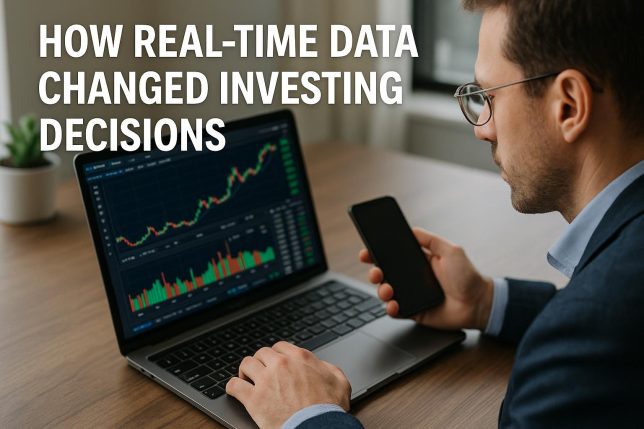
The Impact of Real-Time Data on Investing Decisions
In the past decade, technological advancements have significantly transformed the landscape of investing. One of the most profound changes has been the introduction and integration of real-time data in crafting investment strategies. This shift has allowed investors to make more informed and timely decisions, optimizing their portfolio management and strategy formulation.
Understanding Real-Time Data in Investment
Real-time data refers to the immediate availability of information as it is generated. In the context of financial markets, this encompasses anything from live stock prices and market indices to news flashes and economic indicators. With the advent of high-speed internet, data analytics tools, and mobile applications, investors can access this data instantaneously, regardless of geographic location. For more insights on cutting-edge market tools, consider checking platforms like Bloomberg or Reuters.
Speed and Efficiency in Decision-Making
One critical advantage of real-time data is the increase in speed and efficiency with which investors can respond to market changes. In volatile markets, where conditions can shift rapidly, having access to fresh data can be crucial. This immediacy allows investors to quickly adjust their positions or strategies to mitigate risks or capitalize on emerging opportunities. For example, the ability to rapidly react to a sudden change in commodity prices or geopolitical events can be pivotal in preserving capital and maximizing returns.
The immediacy provided by real-time data transforms the decision-making process, enabling a more agile approach where investors can stay ahead of market movements. This agility ensures that they do not miss opportunities, as they can buy or sell assets in reaction to the latest information. A company releasing unexpected earnings or a government announcing new regulations can significantly impact asset prices. Those who are on top of these developments can make profitable decisions much faster than those relying on delayed information.
Enhanced Accuracy and Risk Management
Real-time data contributes to more accurate risk assessments and decision-making processes. By constantly monitoring the flow of information, investors can fine-tune their risk management strategies. This real-time feedback loop helps in identifying trends, understanding market sentiment, and anticipating potential disruptions. These insights enable more precise predictions and adjustments to investment portfolios.
The accuracy provided by real-time data facilitates the creation of more robust predictive models. As the data is updated continuously, it allows adjustments to be made in real-time, refining the accuracy of any forecasts. For instance, changes in interest rates or inflation figures can instantly affect valuation models and cash flow analyses. By incorporating this live data, investors can maintain a forward-looking approach, forecasting potential shifts in the market’s landscape while adjusting exposure to various asset classes accordingly.
Integration with Algorithmic Trading
Real-time data is also the backbone of algorithmic trading. Algorithms can analyze vast amounts of data within seconds to execute trades based on pre-defined criteria and models. This approach reduces human error and emotions in trading decisions, ensuring trades are executed with consistent effectiveness. The high-frequency trading aspect of this strategy thrives on the immediate availability and processing of data streams.
The integration of real-time data with algorithmic trading presents remarkable efficiency. Algorithms can operate on a level of precision and speed unattainable by human traders. By discerning patterns, price discrepancies, or arbitrage opportunities, these systems can make hundreds of trades a second, generating profits on small margins. They are particularly valuable during market hours when trading volumes are high, and slight movements can be capitalized on profitably.
Implications for Retail and Institutional Investors
The democratization of real-time data has leveled the playing field for both retail and institutional investors. Platforms such as Robinhood and eToro have capitalized on this trend, offering tools that provide real-time market insights to everyday investors. As a result, individual investors now have access to information that was once the exclusive domain of professional traders.
The implications of this are far-reaching. Retail investors, who previously might not have had access to the same breadth of data or the tools to interpret it, can now compete more effectively. These platforms often provide educational resources and analytical tools, empowering individual investors to glean meaningful insights from real-time data. Additionally, because these tools are user-friendly, they help bridge the knowledge gap between seasoned investors and newcomers.
Institutional investors can also optimize their strategies by leveraging real-time data. The ability to analyze large volumes of data quickly allows them to manage vast portfolios with greater precision. Whether reallocating assets, hedging against risks, or identifying new opportunities, this data enables institutions to remain competitive in an increasingly fast-paced market environment.
Challenges and Considerations
Despite its benefits, the use of real-time data in investing does come with challenges. The sheer volume of data can lead to information overload, making it difficult for investors to discern which pieces of information are most relevant to their strategies. Moreover, the quest for instant data can sometimes lead to impulsive decisions that might not align with long-term investment goals.
This information overload can result from the relentless influx of data points, each of which can appear critical at the moment. Navigating this sea of information requires robust data filtration methods to distinguish noise from valuable insights. Without a clear strategy, investors risk making short-sighted decisions driven by temporary market fluctuations rather than fundamental values.
Furthermore, the reliance on data and analytics necessitates robust cybersecurity measures to protect sensitive financial information and trading strategies. The risk of data breaches and cyberattacks is a growing concern that requires vigilant monitoring and defense strategies. Given the financial sector’s reliance on technology, developing solid protocols for data protection is paramount to safeguard assets and maintain investor trust.
Conclusion
Real-time data has fundamentally transformed the way investors approach decision-making, enabling faster, more accurate, and insightful strategies. As technology continues to evolve, its role in investment decisions will likely expand, offering even more sophisticated tools and techniques to navigate the complexities of financial markets. It remains essential for investors to balance the advantages of rapid data access with thoughtful, strategic planning to maximize their investment returns effectively.
In conclusion, while real-time data presents multifaceted advantages, it is crucial to couple this technology with sound investment principles. Effective utilization of real-time data involves understanding its limitations alongside its benefits. By mastering this balance, investors can harness this powerful tool to drive their financial success while mitigating inherent risks.
This article was last updated on: May 22, 2026